PPM checks
- Hours a year of planned maintenance
- 64
- Computed on this page from the inputs below
- Checks on one visit
- 252
- Computed on this page from the inputs below
- Hours one visit takes
- 30
- Computed on this page from the inputs below
- Hours per engineer on the visit
- 30
- Computed on this page from the inputs below
Every figure on this site comes from the numbers you enter and the method printed beside them: your assets, your checks, your minutes, your visit frequency and your defect rate. Where a guide names a published document it names the document and the date it was read. This site publishes no statutory rule text, no certificate and no contractor's price.
Email me this result
We will send you these figures and a link back to them. One email, nothing else unless you tick the box.
The figures shown are a worked example for a small site: 64. Change them for your building.
Download the PPM checks worked example (CSV)
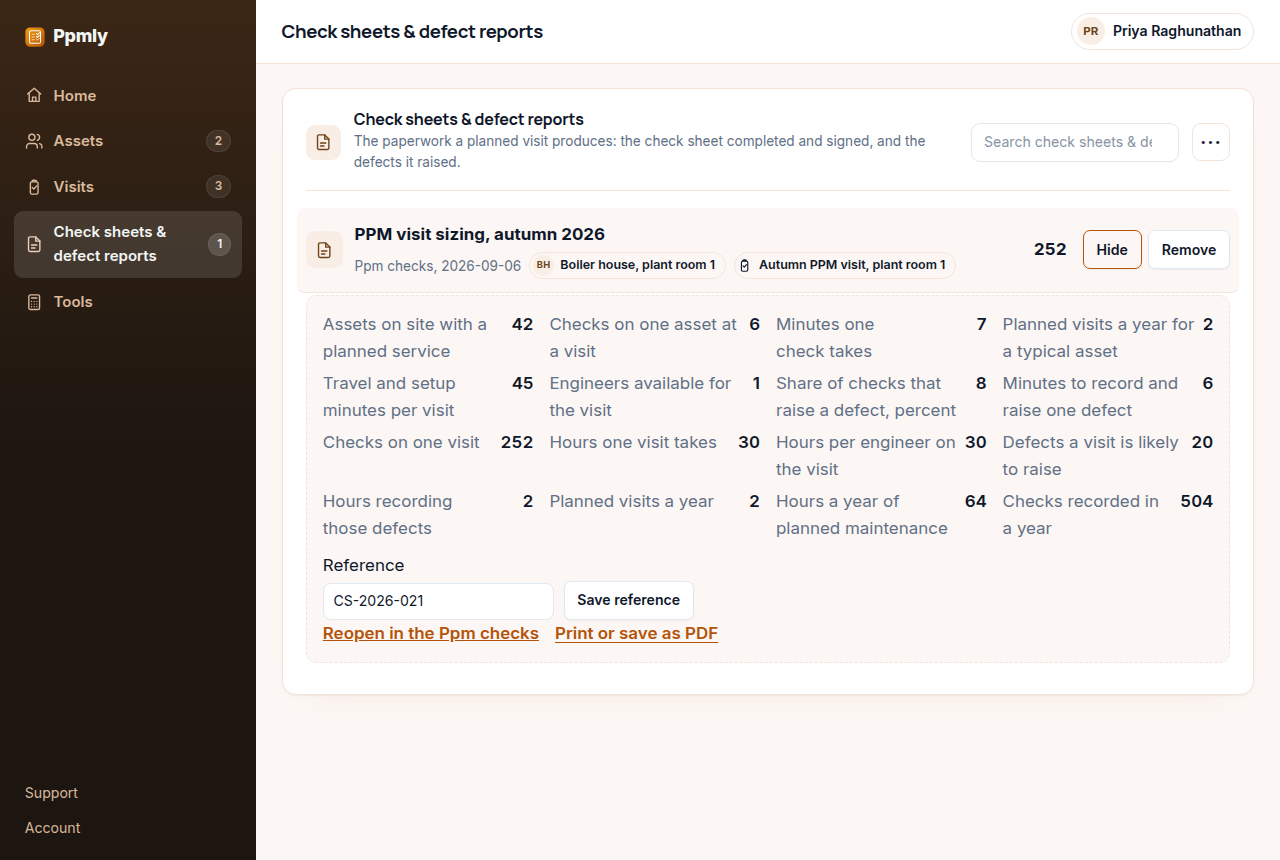
PPM checks are the individual tasks a planned visit performs on each asset, and the check sheet is what the engineer carries and signs. This one is built from your own site rather than a generic template: put in the number of assets with a planned service, the checks each one takes at a visit, the minutes a check runs to, how often the assets are visited, the travel and setup time, the engineers on site and the share of checks that raise a defect. It returns the checks in one visit, the hours the visit takes and the hours per engineer, the defects to expect and the time to record them, and what the whole regime comes to in hours across a year.
Ppmly Pro
Keeping the proof between visits
Upgrading turns the sheet into the register. The assets you sized become the asset register; the intervals become a schedule that says what is due this month; the completed visit becomes the proof, dated, against the asset it was done on. Export is always available, so the maintenance history is yours whether or not you stay.
- Take the completed check sheet away as a file for the building's records.
- Issue paperwork with your name on it and without ours.
- Keep the sheet you sized and open it again next quarter.
- Put your organisation's name on the check sheet and the defect report.
- Export the whole maintenance history in one go, including on the way out.
- Send the check sheet or a defect report from the record it came from.
- Connect your own Stripe account if you bill maintenance on.
- Connect the bookkeeping you already file with.
£50per month, whole team
Start Ppmly Pro Free for 14 days. No card needed. PricingThe first 14 days are free and no card is asked for. Add a card during the trial and the first charge is on the day it ends; do not, and your workspace becomes read-only with nothing deleted. Ppmly Pro is £50 a month and renews monthly at £50 a month until you cancel. The price and the renewal date are shown before you pay.
What a facilities manager asks before running the PPM checks
What are PPM checks? The tasks performed on an asset at a planned visit: the inspections, tests, cleans and readings that make up the service. They are what the check sheet lists and what the engineer signs against, and they are the unit this worksheet counts.
How long should a PPM visit take? It follows from the arithmetic rather than a rule of thumb: assets times checks times minutes, plus travel and setup, plus the time to record the defects it raises. Run it with your own numbers and compare the answer with the window you actually give the engineer.
Why does the sheet ask about defects? Because they are the part everybody underestimates. A visit that raises a dozen defects and records none of them properly has failed at its main job, which is producing the evidence, and the minutes it takes are the difference between a visit that fits its slot and one that overruns.
Does this replace a statutory inspection? No. Statutory inspections have their own requirements and their own competent persons, and this site publishes neither. The sheet sizes the planned work you have decided to do; what the law requires of your building is a question for whoever advises you on it.