What it is built around
Ppmly: The planned visit and the proof it happened
A full CMMS: The work order, raised and closed all day
Assets, schedule, proof
Ppmly is for the person who has to keep a building serviced and prove it: the facilities manager of a school, surgery or office, the managing agent with a block to look after, the supervisor who books the engineers and holds the paperwork.
Free for 14 days. No card needed.
Ppmly Pro is £50 per month for the whole site, billed monthly.
Tools
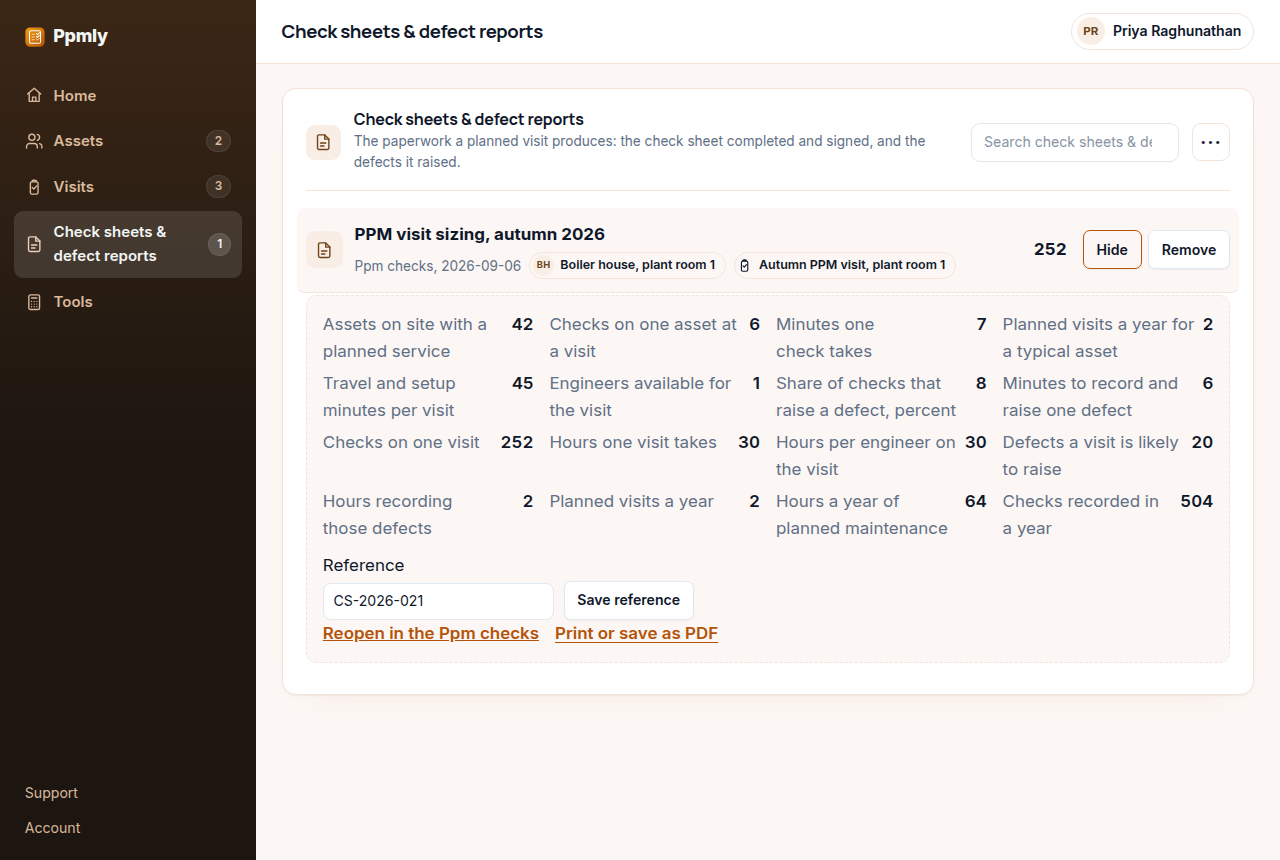
PPM here means planned preventative maintenance, not parts per million. The free check sheet works out, from the assets on site and the checks each one needs, how long a visit takes, how many defects it is likely to raise and what a year of it comes to in hours.
Ppmly Pro keeps the asset register, the schedule those assets sit on, and the completed visits that answer the question an insurer, an auditor or a landlord eventually asks.
Free to use. No account, no card, no sign-up.
In figures
7 to 28day
Range of the published figures
9 sources with a published figure, read 18 October 2026.
Ppmly Pro
£50
per month, whole team
Upgrading turns the sheet into the register. The assets you sized become the asset register; the intervals become a schedule that says what is due this month; the completed visit becomes the proof, dated, against the asset it was done on. Export is always available, so the maintenance history is yours whether or not you stay.
Free for 14 days. No card needed.
Ppmly Pro is £50 per month for the whole site, billed monthly. Billed monthly. Cancel any time from your account page. Price and renewal terms are shown before checkout.
The register is the thing everything else hangs off. Without it the schedule is somebody's memory of what was on last year's list, and the first question after a failure, which is whether that asset was even on the regime, has no answer.
A schedule that lives in a spreadsheet drifts: a visit moves, a contractor changes, and by autumn nobody is sure which quarter an asset is on. Holding the interval on the asset means the month's list is derived rather than maintained.
The question that arrives after an incident, an insurance claim or a change of managing agent is always the same: show me that this was serviced. A visit marked complete against the asset, dated, with its defects, is the answer that takes a minute rather than a week.
If you are maintaining a production line, tracking spare parts and inventory, and running work orders raised by operators all day, a CMMS is built for that and Ppmly is not. Ppmly is for a building whose maintenance is planned rather than reactive, where the hard part is proving the planned visits happened.
Ppmly: The planned visit and the proof it happened
A full CMMS: The work order, raised and closed all day
Ppmly: One person keeping a building or a small portfolio serviced
A full CMMS: A maintenance team with operators raising jobs
Ppmly: Not covered; the record is the visit and its defects
A full CMMS: Usually central, with inventory and reorder
Ppmly: Assets, schedule and visit history as a file, any time
A full CMMS: Varies by vendor; ask before you sign
The comparison is category level and names no product and no price. What a particular CMMS charges is on that vendor's own pricing page, and this site quotes no competitor's figure.